

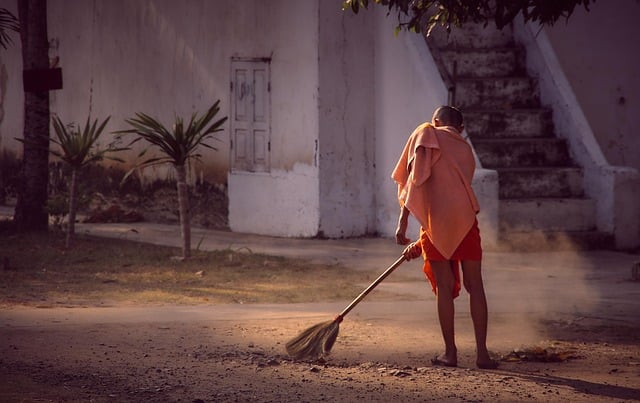

The foul smell of the drain is like rose petals; the dumping site where nothing but garbage is piled is a sight for sore eyes; the sound of a sweeping broom is music to the ears; the sharp thorns in the grass used to make a broom is as smooth as silk; the air filled with dust and dirt is refreshing; Because sweeping and cleaning is my purpose, my destiny, my life.
–Broom (Jhadu)
The birth of a broom takes place in the narrow lanes of the rural areas in Rajasthan and the by-lanes of Jodhpur city. The life of a broom evokes a new emotion at every step. A different level of sadness hits you when you discover the reality of the caste-system prevalent amongst the broom-makers, garbage collectors, and municipal sweepers of India. Curiosity arises when you read about the stories of countless superstitions associated with the most humble and inconspicuous object of everyday life- ‘Broom’. Rage surrounds you when you stumble upon the age-old tale of the gender, socio-economic, political, and cultural divisions in these industries.
The struggles and resilience of the women who make brooms without a roof over their heads and who clean houses, offices, and roads with those brooms without access to any clean drinking water, as they are considered ‘untouchables’. Yet they do it every day because it is their livelihood. It is how they provide food for their family of ten members or so.
But this is not a livelihood they chose. This is a vicious circle of poverty they were born into and are forced to stay in. India got independence in 1947, but these citizens of India, the most downtrodden caste groups, never got a taste of that freedom. What makes me disappointed the most is what they experience daily- political apathy, untouchability, meagre earnings, harassment, and humiliation at the hands of other Indian citizens who are supposed to be their brothers and sisters as per the National Pledge. We are either blinded by our privilege or hiding behind the infamous line- “Yeh to kaafi saalo se hota aa raha h” (This has been happening for so many years) that we forget the fact that we are all humans, homo sapiens at the end of the day. Jain, Aggarwal, Brahmin, Harijan, Akhateej Bhils, Bagaria, Bhatadia, and endless other communities that we are divided into do not give us the right to treat someone as a lesser person.
I believe that when we can’t justify our actions and behaviour on moral grounds, we try to hide behind a thick veil of prevalent superstition as if these are sanctified by our holy book, the authenticity of which is impossible to prove.
We have our reasons to believe in superstitions, however logical or illogical they may seem. Sweeping early morning to erase the footsteps of the devils that were out at night. Not sweeping after sunset as it is the supper time for God, Bavasi, and the dust might go into His plate. Not sweeping for at least 24 hours after the wedding of a daughter because you don’t want to erase her footsteps or give her a broom as a gift, as it brings Lakshmi (money), and you don’t wish to give it away. Not stepping over a broom, not hitting it, keeping it at a height, in a sleeping position, hidden inside the house, not hitting a child with a broom, as in the next life, you will be a slave to that child for as many years as there were twigs in the broom. Not buying a broom on Tuesdays and Saturdays, as those are inauspicious days, but buying a broom on Dhanteras as that is an auspicious day. Offering a broom to Jharu Baba so that he fulfils your wishes. All of these are harmless superstitions that people believe because they want to. Our job is not to judge them for these superstitions but to respect their beliefs.
A broom made of peacock feathers is used to dust the pictures of the Gods in a shrine and to cure illness with a tap on the head using tantra-mantra. A broom made of Vipuno, Buado, Heenyo, and Kheemp is used to sweep outside the house, while a broom made of Khejur, Alya, or Daab is used to sweep inside the house. Phool Jharu is used to clean concrete floors. All these are not only based on the different materiality and cost of the broom but also on the traditional knowledge and the superstitions associated with it.
It is also said that a woman is uncultured if she scatters the broomsticks while sweeping. It is better to sweep with a bent hand than a straight hand. If a daughter-in-law doesn’t sweep properly, she is sent back to her parents’ house, and a new wife is picked for the household. The men of the household do not even touch a broom as sweeping the house is considered a woman’s job. It is hard work without any pay.
On the other hand, making and selling a broom is hard work with low margins, and those margins are getting narrower as human labour is being replaced by machines. Their livelihood is being threatened. The broom is considered an auspicious object and is worshipped in our country. Yet the women who make it and use it are considered untouchable. The women who clean our houses, offices, roads, schools, colleges, institutes, and our spaces are considered dirty and impure. The irony is not lost.
To say that broom-makers lead a difficult life would be a massive understatement. Unfortunately, they can’t turn the broom into a magic wand and fly away from poverty. Thus, each day they wake up and treat those brooms like swords to fight and live another day. One thing that would make this battle with the broom a whole lot easier for them is if we sweep the cobwebs of gender inequality, untouchability and the caste system out of our mindsets.
******
***
The ManifestStation publishes content on various social media platforms many have sworn off. We do so for one reason: our understanding of the power of words. Our content is about what it means to be human, to be flawed, to be empathetic. In refusing to silence our writers on any platform, we also refuse to give in to those who would create an echo chamber of division, derision, and hate. Continue to follow us where you feel most comfortable, and we will continue to put the writing we believe in into the world.
***
Our friends at Corporeal Writing are reinventing the writing workshop one body at a time.
Check out their current online labs, and tell them we sent you!
***
Inaction is not an option,
Silence is not a response
Check out our Resources and Readings
