

I sat at the red light, with all the songs on my playlist sounding wrong.
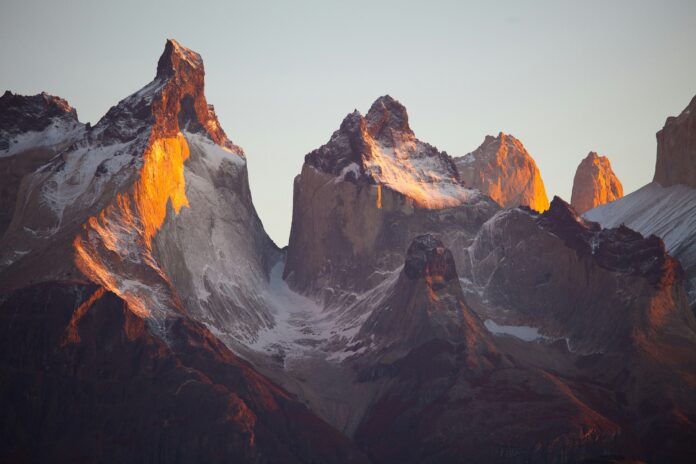
When I trudged up the hill in my green Volkswagen, the sky opened and I couldn’t breathe for a second. The clouds looked exactly like the mountains I could see from the little valley we lived in last year in Switzerland, with snow on top of the peaks. I don’t know how to describe those mountains if you’ve never really seen them. Like giants in the sky, with gentle edges, standing solid, hugging you from all sides. A constant presence that was familiar and stable. You were never alone. No matter where you looked, a curved contradiction to the earth lifted you up, giving you more space in the world.
Two years ago, before we met, I knew nothing about the geology behind mountains. But they can form in different ways. Usually, the tallest and most dramatic ranges are created by convergent plates. The collision forces rock layers upward, forming massive mountain chains over millions of years. The harder they collide, the stronger the structure.
You were my first relationship. We matched on Tinder in New York and you asked me to go to the beach before I could fully introduce myself.
I dug us a sand hole, put some blankets down, and waited. As soon as you arrived, you whipped off your shirt and walked toward the sea. You couldn’t wait another minute to touch the water; you were so desperate for her tide to tear into you. You held your breath as you dove under, not sure what kind of embrace she would offer this time.
Mountains often serve as geographic features that define natural borders of countries. Their height can influence weather patterns, stalling storms that roll off the oceans and squeezing water from the clouds.
I was so in love. Everything you touched was golden.
When I took you to the Catskills for our first weekend away, it was overwhelming. I had still not gotten used to the beauty of the mountains there. Coming from the flat lands of Maryland, where I could see for miles, it was all so new. We went in October and jumped through the forest from rock to rock, trying not to slip on the orange and brown remnants of wet leaves. We held hands as we dove through the wooded path and trampled the moss like they were our doorstep. You taught me the word girlfriend in German, and I repeated it over and over until it sounded familiar.
I was in awe of the ranges. I wanted to sit and gaze at their beauty. But you looked at them there and fell quiet. You wanted to move on. You called them hills. Wait until I show you the Alps.
Switzerland is home to the Alps, the famous mountain ranges that punctuate central Europe, spanning across France, Switzerland, Italy, Austria, Germany, Slovenia, Liechtenstein, and Monaco. The Alps are a prime example of a fold-and-thrust mountain range, with rocks that have been pushed up, folded, faulted, and metamorphosed due to the collision of the African and Eurasian plates.
I was out of breath. On our first hike there, when I told you, “I’m not very fast going uphill,” and you laughed and said it was okay. We could take our time. It was 1200 meters in two hours. Sometimes more. Your pace was quick and constant. But you didn’t seem to mind my uncertain steps. And so we stumbled through it. Up the hill, the mountain.
Over time, I would trail behind you more and more, on my bike in Zurich, or on foot on the trails, and I would see you walking ahead with such confidence and buoyancy, I thought for sure you wouldn’t notice if I disappeared into the cracks in the rocks. Sometimes you would extend your hand, without looking back, and squeeze it three times, as if offering me the opportunity to catch you. It felt like a tease. You knew I couldn’t reach you. I reached my hand toward you anyway and sighed into the empty space between us.
Mountains are constantly moving, both vertically and horizontally, due to tectonic plate movement and other forces. New research reveals that mountains are also, in fact, swaying gently from the seismic rhythms coursing through the earth upon which they rest. While the movement is typically slow and gradual, it can also be accelerated by events like earthquakes. They never stand still, even though they appear sturdy and stagnant.
We were long distance for one year, and then as soon as I graduated college, I moved to Switzerland to be with you.
The mountains there engulfed me. I felt like I was placed in an imaginary world, with cotton trees and woven rivers. I never tasted a life this sickly sweet and juicy. Concentrated. It felt like holding a watermelon over the kitchen sink, trying to suck up the juice as it runs down your wrists.
But no matter how hard I sucked and licked and fell to my knees to sip up the excess, I came to find the days were dry. The stability that lured me was suddenly a cold edge slicing the bottoms of my feet.
Freezing winter. Turning the heater down to 1 when I wasn’t looking. An empty bed. Phone light until noon. Untouched vases. A calendar with my crossed-out name. I got high in the bath every night just to have something to do.
Then, alone on the train. Trying to catch up to your plans again. Voicemail. Sleeping at friends or in parks, avoiding your pillow. No answer. Crying in McDonald’s because it’s the only thing open past 5pm in Switzerland. Your dad’s eyes filled with pity, your mom whispering your name in disappointment. Graduate school commitments, job offers accepted, vacations where I am left at home. You told me nothing of it all. You slowly left me behind, without anything to tether myself to. You made your own decisions, etching them into stone carefully, taking your time, weeks and weeks to decide, with one set of our eyes closed. With mine cut out like buttons. Rusty scissors. Pale wrists. I didn’t even realize I could see the mountain range out of our window until spring. I didnt’ look out the window until then.
Visibility in mountainous terrain is often limited due to factors such as steep slopes, dense vegetation, and variable weather conditions like fog, clouds, or heavy precipitation. These elements can obstruct the line of sight, making navigation and observation challenging, and require specialized equipment or techniques to ensure safety and orientation in such environments.
In summer. Back home. You called me today, the first time after we decided to take a break while I’m in New York. I didn’t recognize the name on the screen at first. I didn’t get the usual lurch in my chest, the chills down my arms, the tug on my lips, the push on my lungs. I was completely still. I hovered over the answer button.
“Are you okay?” I texted instead.
“Sorry for calling.”
I called you back. Your voice was tight when you answered, like you had been crying or screaming or both.
“Hey bug,” you said with a crack in the middle. You’d been fighting with your parents about money. “Everything is falling apart, and I just needed to know that you were still there,” you said.
I sat in that orange coffee shop. They called my name in a whisper as they slid my latte across the counter, noticing that I was distracted by the phone.
“I’m still here,” I said.
Strength bubbled up inside me. I had spent the last two weeks of silence building up my identity pebble by pebble. I had filled the cracks and wiped out the sand.
I heard in your voice how much you wanted to give me the security you promised. How you wanted to ask me to stay with you, how you missed the permanence we built together. But I could also hear the regret. The panic. The pace four steps too fast for me, the calendar full and the vases still empty.
I sat on the phone and listened while you cried and struggled between, “I don’t want to talk about it” and “Please don’t hang up.”
Volcanic mountains commonly form along subduction zones, where one tectonic plate is forced beneath another. As the descending plate melts, magma rises to the surface, it cools and solidifies, creating the characteristic cone-shaped mountains we recognize as volcanoes.
I’m in a phase right now where I rage at insecurity. If someone’s voice lifts at the end of their sentence, if they duck down when they answer a question, if they look away, I want to shake them. I want to grab them by the shoulders and look them in the eyes, deep deep, into their more shadowy parts, and whisper, be brave for god’s sake.
I grew up with parents who acted confidently, but I am now seeing how they flail in the world. When they don’t understand, they don’t ask for help or admit it. They push through and around the problem and hope the answer isn’t relevant. I am in a phase right now where I can’t stand anyone not holding their ground.
Mountains don’t last forever. Through erosion caused by wind, water, ice, and gravity, the rocks that make up mountains are gradually worn down and carried away. Geologists have studied how quickly the Himalayas erode, and even at slow rates, the landscape is constantly being reshaped. If Mount Everest were left to erode without any additional uplift, it could completely wear away in about 88.5 million years. While that sounds like a long time to those of us who only live for a few decades on this planet, the Earth has been here for 4.5 billion years. You could completely erode Mount Everest 50 times over since the planet’s origin.
I still look up at the sky and expect mountains to be there. After 8 months surrounded by their shadows, the sky looks empty without their jagged edges.
Did they become soft and tumble into the earth again, after centuries of standing so tall? Did they make other plans and slip out the back door at night when the tides were asleep and couldn’t hear their footsteps? Or did gravity eventually wear them down, their defiance, their inability to stop growing, resulting in defeat?
It doesn’t really matter where they went or why. They are not here right now. And I am left with the clouds, reminding me of the cold snow on the caps and of the winter I didn’t think I would survive.
***
***
The ManifestStation publishes content on various social media platforms many have sworn off. We do so for one reason: our understanding of the power of words. Our content is about what it means to be human, to be flawed, to be empathetic. In refusing to silence our writers on any platform, we also refuse to give in to those who would create an echo chamber of division, derision, and hate. Continue to follow us where you feel most comfortable, and we will continue to put the writing we believe in into the world.
***
Our friends at Corporeal Writing are reinventing the writing workshop one body at a time.
Check out their current online labs, and tell them we sent you!
***
Inaction is not an option,
Silence is not a response
Check out our Resources and Readings
