
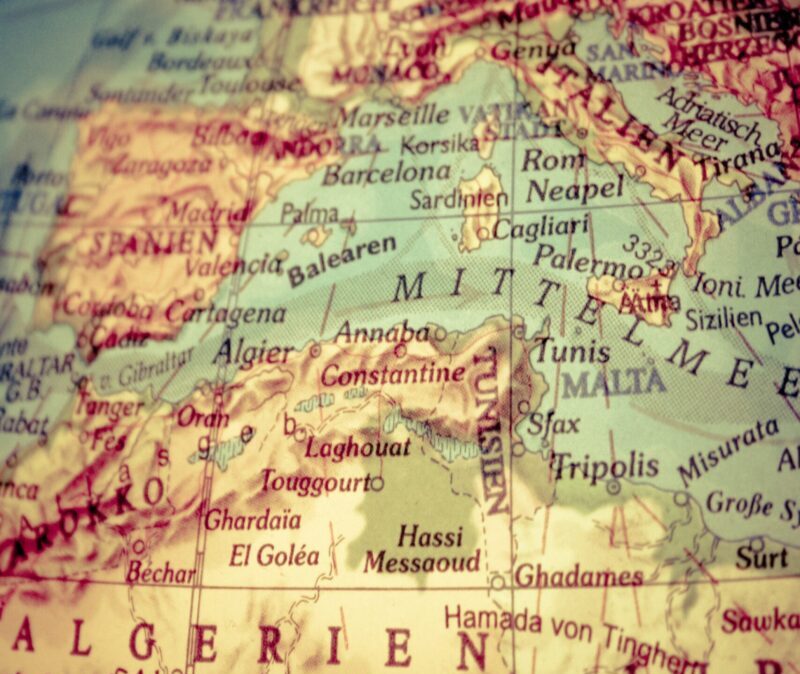
Some maps included islands that never existed. Cartographers drew them anyway. Small shapes in the Atlantic or Pacific Ocean, copied carefully from chart to chart for centuries. Sailors searched for them and returned empty-handed, but the islands often remained on maps. There was always the possibility that someone had simply missed them.
One of them was called Hy-Brasil, drawn west of Ireland for hundreds of years. Circular, split through the center by a narrow channel. According to legend, it appeared through the fog once every seven years, then vanished again.
Eventually, mapmakers stopped printing it.
—
I still remember hanging up the map in my house ten years ago. My brother taped the top corner that I couldn’t reach to the wall crookedly and said, “Study up. You’ll never beat me at Atlas otherwise.”
Atlas had become our road trip game for as long as I could remember. My brother used to beat me every time, which frustrated me, even though I knew he had a five-year headstart. Sometimes he made up fake countries just to see if I would believe him.
“Albania.”
“Azerbaijan.”
“Namibia.”
“Stop saying countries that end with A!”
Since then, I didn’t go a day without staring at the map. At night, headlights from passing cars moved across the oceans in pale streaks. The paper smelled faintly of dust in summer when the windows were open. Over time, the Pacific faded lighter than the Atlantic because the sun reached it first.
I memorized every country, its capital, the bends of coastlines, outlines, subdivisions, highway systems, electrical poles. Yellow license plates in Colombia. Unique road lines painted on Route 5 in Chile. The black and yellow hazard markings painted along Taiwanese utility poles.
It felt comforting, memorizing every detail until the world seemed small enough to understand. At least I knew something for certain.
Eventually, my brother stopped playing Atlas with me because the games went on forever. But even as time flew away, I still looked at the map before going to sleep.
—
The Darién Gap is the only interruption in the Pan-American Highway, a road that was meant to stretch continuously from Alaska all the way to the Southernmost point of Chile.
For nearly nineteen-thousand miles, the highway remains connected. That is, until it reaches the border between Panama and Colombia. A sudden cut. Like someone accidentally erased a segment of the continent. Despite being a patch of land filled with nothing but dense rainforest and swampland, hundreds of thousands of asylum seekers cross the treacherous gap every year. They travel for days through floodwater and jungle, carrying children or plastic bags filled with the few things they could not leave behind.
On maps, the interruption looks surprisingly small.
—
In middle school, my dad started asking what I wanted to become. The first time, I said I didn’t know, thinking that I would have time to figure things out. My answer, or a lack of one, seemed to genuinely unsettle him. The next month, he asked again.
“Don’t you at least have a general direction of what you want to do? You’re already 13. Most children have passions at this age.”
And what if I don’t. I thought, but wouldn’t dare to say out loud. I just stared at the wall behind him, refusing to show my fear of the future.
“Lawyer?” I shook my head.
“Science or math?” I hated science and math. He knew that.
Feeling pressured to muster up something so he would stop pestering me, I said, “Maybe English? Like an author.” I didn’t want to be a writer, that was for sure, but it was the best answer I could come up with. The answer sounded artificial even while I was saying it.
If only answering his question was as easy as recognizing countries based on their utility poles.
—
For several months, when I looked back at my map, my eyes drifted toward the Aleutian Islands. A chain of treeless volcanic islands extended west from Alaska in such a long arc that it nearly reaches Asia, frequently battered by storms moving across the North Pacific.
I imagined taking a boat there and disappearing for a while. Camping along the volcanic beaches, and sitting in silence until the land was swallowed completely by the fog. I imagined what it would be like to be an explorer back in the day when the world still needed them, when parts of the world still appeared unfinished on maps. To sail through the waters surrounding Tierra del Fuego like Magellan and believe there were still places no one fully understood yet.
—
Last Christmas, my brother came to visit for the first time in a year. Only five days off. One night, my brother showed me a photograph on his phone and asked where I thought it had been taken. The image was of a small European town with Germanic style houses, with Alpine mountains in the background.
“Austria,” I said casually.
He nodded once, then scrolled to another photo. Again, another European town. I looked closely and saw concrete utility poles with white paint on the bottom.
“Romania.”
“Yeah, I took this when I went there last year,” he replied.
A few years earlier, he would’ve corrected me immediately. He used to answer his own question before I had time to think. He took his phone away, unamused at the fact that he couldn’t stump me anymore. For the first time, neither of us seemed interested in whether I was right.
He went back to London a few days later, without knowing when the next time he would see us again would be.
—
As we’re getting ready to sell our house and move out at the end of the month, I took down the map from my wall for the first time. The paint underneath had faded differently from the rest of the room. Dust lined the edges faintly where the paper had hung for more than a decade.
As I folded it inward, I noticed a small dot in the middle of the Pacific I didn’t remember seeing before. Midway Atoll.
—
Midway Atoll is made up of less than six square miles of land, isolated in the North Pacific nearly equidistant from Asia and North America (hence its name). Most people know it because of the battle fought there in World War II, but before that, it was a stopping point for ships and planes in the middle of a long journey. Most people passing through never intended to stay there.
Albatrosses return there every year after spending months flying over the open ocean. They travel thousands of miles before arriving back at the same small stretch of land. Scientists say they navigate partly through smell, partly through magnetic fields, though nobody is entirely certain how they find their way across that much water without getting lost.
Most photographs of the atoll look like a temporary snapshot in time. Runways overtaken by seabirds, paired with rusted structures facing the ocean as if waiting for something that already left long ago.
—
With each fold, the map became smaller very quickly. Oceans I once imagined sailing through were reduced into inches, borders I once traced becoming no more than lines of ink. Near the bottom corner was the printed scale, remaining perfectly unchanged.
The Aleutian Islands disappeared first, then Midway Atoll.
By the final fold, the oceans existed only where the paper overlapped. I placed the map into the box with the rest of my childhood things and taped it shut.
***
***
The ManifestStation publishes content on various social media platforms many have sworn off. We do so for one reason: our understanding of the power of words. Our content is about what it means to be human, to be flawed, to be empathetic. In refusing to silence our writers on any platform, we also refuse to give in to those who would create an echo chamber of division, derision, and hate. Continue to follow us where you feel most comfortable, and we will continue to put the writing we believe in into the world.
***
Our friends at Corporeal Writing are reinventing the writing workshop one body at a time.
Check out their current online labs, and tell them we sent you!
***
Inaction is not an option,
Silence is not a response
Check out our Resources and Readings