

Today, bored while waiting on my groceries in the Walmart parking lot, I picked up my phone and checked my email, a habit I’ve had since email became a thing, made infinitely worse by the phone. The news today was not good. Annie Dillard had died.
I received an email from her once while I was working as an adjunct writing instructor at NSU’s Leesville campus. Had I known then how rare such a message from her would become, I would have printed that missive. Framed it.
I did not merit a computer of my own at work, and so between classes I used the student computer lab to write syllabi, print them, and, increasingly, check my email. It was a compulsion, like smoking. I needed something to occupy me in the stale and sterile office building with the drab carpet and drabber walls, or I would simply fly apart.
One student, older than I was—they were all older than I was—curbed my habit temporarily by asking, as if he knew the answer already, “Why do you check your email so often?”
I couldn’t tell him, “Because I need a connection, no matter how wispy, to something else, some hint of life outside these walls, beyond papers about dying grandmothers, childhood pets, and how to change the oil in a car, beyond mere assignments on the way to better jobs where a 1,000-word essay on anything would be as rare as a tree with lights in it.”
I just stared at him and shrugged, at a loss to explain how disappointed I was that he was not a frog whose innards were being sucked out by a giant water bug.
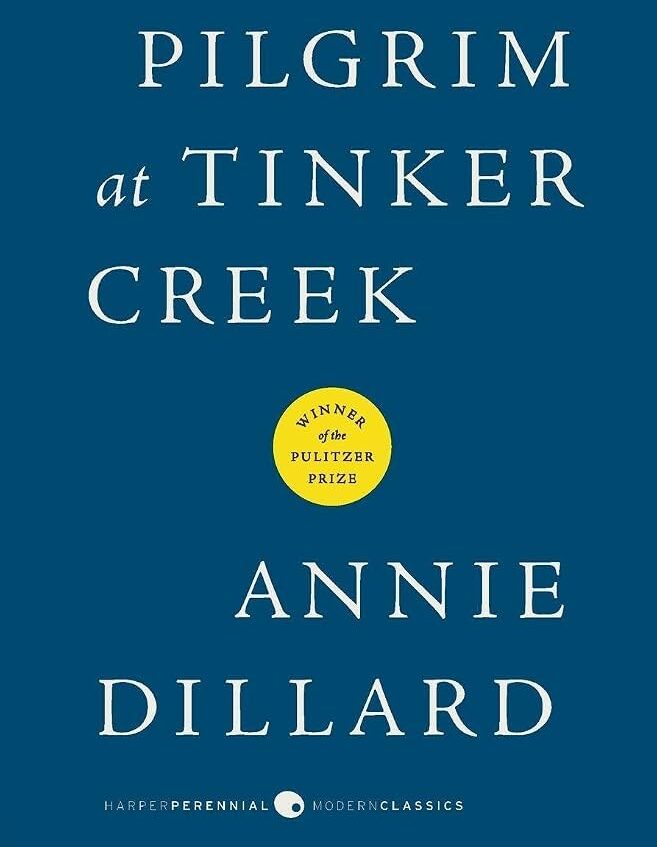
I had just spent several weeks reading Pilgrim at Tinker Creek and felt I had loads of things to observe and be astonished by outside, yet I was trapped inside by the odious need to “make a living.” Every morning that I was free while reading Tinker—and ever after—I have felt compelled to go on a long walk, preferably to a creek, to see what I could see, to at least make it possible for the world to astonish me with its strange life. Every once in a while I do see something and that keeps me, like Pavlov’s dog, going.
Shortly after reading Tinker, I found myself sitting on the edge of my very own creek, Elder Creek, in which I had been baptized at the age of 7, contemplating how I could write a masterpiece like Dillard. I seemed, miraculously, to have all the same pieces as her: a creek, time for walks, a calling to write, belief!
Despite having devoured most of her books, I was still writing drivel no one wanted to read.
But I wrote anyway because how could I not? The two water moccasins entwined with a ray of sun on the creek’s culvert flicked their tongues, seemed to taste the cigarette smoke that drifted from me to them while I studied them.
Who else would write about them? There was no one else there to see this gift. It was a foregone conclusion in my mind.
The internet had already become a thing by then. At work, bored again, I looked her up. And there, like a beacon, was her email address.
I dashed off a letter about how her book had inspired me and how the two snakes engrossed me daily. They were always there.
The next day I fairly ran to the computer lab and returned every spare minute thereafter to check my email until my inbox rewarded me with her name in that peculiar computer green phosphor. Courier. Monochrome. Monospaced.
Annie Dillard!
She seemed upset that I was stalking snakes and warned me that even harmless-looking snakes could bite. I was suddenly glad I had not told her I was stalking pit vipers.
“Oh, don’t worry!” I typed back, vaguely disappointed that she had not said anything about my prose concerning the snakes. “It’s not like I’m poking them with a stick.”
Or something inane like that.
She never wrote me back. Years later I wondered if she had regretted the close calls she’d brought on every would-be writer sticking their noses in the animal and insect world like they belonged, tempting fate. No wonder she stopped answering her mail. Or maybe it was like she said on her website when I looked her up again years later: she couldn’t possibly answer all the mail and still do her own work.
Thirty years later, unaware that Annie Dillard lay dying, I revisited Elder Creek earlier this week.
I needed to write a poem to round out a book. I needed to visit my old stomping ground. I took Rocky with me.
From Self Cemetery, we walked down Barham Road to the creek—slowly because sometimes I write while I’m walking, typing my thoughts into my phone. Head down, I shuffle like a teenager with a crush—enamored by the technology or the person on the other end?—as I communicate with someone in the future and far from me.
The creek was just a trickle, a drought survivor nonetheless. My old seat on the bank was grown up, inaccessible now, while a new opening had appeared further upstream, past the place where two creeks converged. I walked in, as if stepping out of my life and back into the creek world. Sand and pine straw, swept against the tree trunks, told me the creek itself had made the spot when the drought broke, overflowing before returning to its banks.
I got closer to the water where things are more likely to happen. Rocky hopped in, walked upstream, taking big gulps, reminding me of other dogs I’ve outlived.
Out of habit, I scanned the area, my eyes landing on the empty culvert.
There were no snakes, no illuminating ray of sunlight, and I did not have time to wait on them. My memories would have to do.
Time is short. I must get to work.
Truthfully, I had been disappointed in Annie. C. S. Lewis had answered his mail—by hand!—and had developed some remarkable relationships through it. Annie had written her own fan letter that led to a marriage—more importantly, an enduring friendship rich with conversation about literature and what things really mean.
That could have been us, Annie, I wanted to tell her, but couldn’t because her address had disappeared from the ether.
Even so, I never stopped checking, hoping for another profound message. Today I got it.
And now I must go back and reread everything else she ever wrote me, for surely it was for me she wrote.
******
***
The ManifestStation publishes content on various social media platforms many have sworn off. We do so for one reason: our understanding of the power of words. Our content is about what it means to be human, to be flawed, to be empathetic. In refusing to silence our writers on any platform, we also refuse to give in to those who would create an echo chamber of division, derision, and hate. Continue to follow us where you feel most comfortable, and we will continue to put the writing we believe in into the world.
***
Write for your Life with The Craft School
CRAFT SCHOOL is a vibrant community for writers led by Jeannine Ouellette, Emily Rapp Black, and Gina Frangello—three established writers with extensive teaching experience. They believe, and we agree, that when a community is both safe and rigorous, writers and their work flourish.
***
Inaction is not an option,
Silence is not a response
See our Resources and Readings

