
I learnt to drive when I was 18 years ago, in my brothers Toyota Corolla. It was the newest car to have hit the market in India in the early 2000s, a sign of the opening economy; post-Soviet restrictions and a new generation of car-drivers was born. People who had access to the newfound wealth that the IT industry brought to India’s Silicon Valley were able to afford new luxuries that only the very wealthy of previous generations could afford. A car was still considered a luxury item in India at that time and the red Corolla was the new joy and pride of our little family. Not just because of what it symbolized, but also of the convenience it brought us. No more getting soaked in the Monsoon rains, no splashing water soaking us when we went out on a post-rain afternoon on our bikes or scooters.
Bangalore then was an idyllic city where cows did roam the streets and the love affair with Soviet Union had recently ended and the US of A was the new darling, on everybody’s mind. McDonald’s had just entered Indian markets a few years ago, in the capital, New Delhi. Imported goods were making their way into the markets and into Indian consciousness.
We graduated from our Bajaj scooters and Vespas, to a four-wheeler and all the complications that came with it, including how to drive them safely on our roads. The almost empty school play-ground we practiced driving was close to our family home and the idyllic summer afternoon, with the sweet smell of Jacaranda trees, a cool breeze amidst the hot tropical summer afternoon was the perfect setting for my driving story to have begun.
The playground was a simple dirt field, which anyone in the community could use, after school hours or on weekends. We used it often, for soccer practice or cricket matches. That week, however, there was no one, so we used it for our driving lessons. My uncle had set up white painted stones for us to turn around, to practice precision driving. He was a fan of doing figure eights and told us that if we could do that, with precision we were able to go on that road on our own.
I had no idea that the lessons that I would learn would come in handy, 26 years later on a different continent, in a context that was not entirely of my own making.
******
My driving instructor was my maternal uncle. This uncle had a few distinctions to his credit: According to family lore, he was the first in the City of Mysore, South India to own and operate a taxi. He was also famous for falling asleep behind the wheel, but somehow getting people to their destinations safely. The one time he was half-asleep, yet managed to make the perfect turn, on the streets of Mysore, gave me the confidence that I was in good hands.
When I was a teenager, a similar incident in his hometown of Mysore, my uncle had demonstrated his experience in driving. You may call it his “magical powers,” given that there was no logical or rational explanation of how he could drive when his eyes were closed. When he drove us to Brindavan Gardens once, he all but slept for a good stretch of the road that stretched for ever – similar to the stretch of freeways between Texas and California, that I have driven through a few times. He seemed to perfectly time his driving to miss a stray cow that had somehow wandered onto the street. How he did it, no one knows. I didn’t dare ask.
The one thing I remember distinctly from the driving lessons is his instruction to use just one hand (the dominant one) while driving and using the palm of the hand to control the steering. “Your control of the steering should be in the palm of your hand. Ideally just one hand and the dominant one,” he demonstrated, as he rolled his right palm over the steering. “More surface area, greater control,” he added. Don’t worry about using the fingers or both hands, they are just a distraction, he added.
Another thing he mentioned is etched in my memory “The most important thing is to be relaxed and confident. Without it, you are dead. Quite literally. Remember that when you are behind the wheel, young man.” He told me in his characteristic sarcastic way. That was my uncle.
My uncle was visiting us in Bangalore, over summer, with his older son and as someone who always wanted to be useful to others, he took on the task of teaching me and my dad to drive. My older brother, who had always been two steps ahead of all of us, had learnt to drive in his own improvised way. Yet, he joined our driving lessons, to improve his technique. It just took three days to learn how to drive and after that he declared “You are ready to go take the driving test, you should feel confident that you will do well.”
I was coming into my own as an adolescent. Driving meant much more than just a mechanical act of learning how to navigate a two-ton vehicle, it meant the freedom to take my mother to her doctor’s appointment, pick up groceries without them tipping out from the bags dangling on my Yamaha bike, and pick up my brothers many suits for his upcoming wedding.
******
Fast forward 26 years, I am now living in Southern California. Having come from the Silicon Valley of India, I am 5 hours’ drive from the actual Silicon Valley and my life has undergone several drastic changes. One of which included a stroke in November of last year. The stroke and resulting disability (only partial, thankfully) led me to re-learn how to walk, how to write and how to do the most basic motor functions of a normal healthy adult.
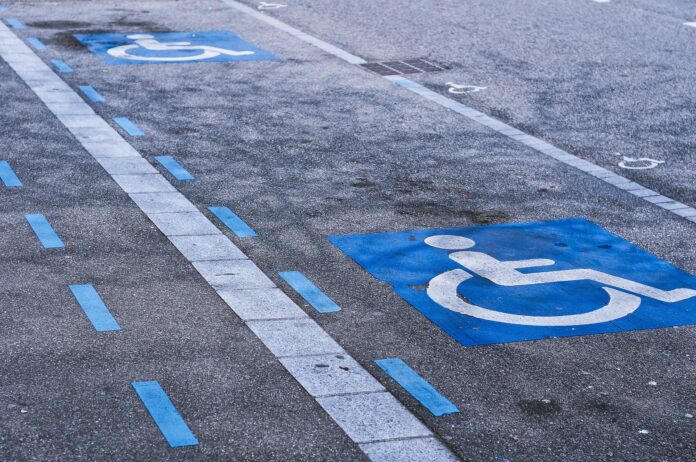
It goes without saying, my license was placed on suspension when I applied for the parking decal, at the DMV. While having the disabled sign was a convenience (while it lasted), getting my license and ability to drive back was a bigger challenge than I ever imagined. I had lost not just my ability to drive, but also the confidence.
I had gotten the decal from the AAA office close to my in-law’s house. My wife had driven us that day. The $6 fee didn’t seem much for the convenience of being able to park at the handicapped spots. But the actual price I would pay, in terms of the stress of getting back my license was perhaps not worth this convenience. I was to later learn that had I not gotten the decal, my license would not have been suspended. Anyway, it was too late, by the time I learnt this fact and I just had to look forward and not backwards. As I picked up the red colored decal and hung it on the rear-view mirror, I suddenly felt disabled. A new category of my identity that I had never experienced. This disability at a relatively young age felt heavy.
As my wife drove us back to my in-laws’ house, I told myself that I would not need that decal very soon and all the “conveniences” that disabled people get. I had to be my old self again. Very soon.
That pre-stroke me became the benchmark. The more I read, the more I reflected on what I needed to do, to get my pre-stroke self-back, I realized that my pre-stroke self-died on that fateful day on November 9, when I had the stroke. I was re-born in a way and had to accept my “new” body and mind. Though they were the same, they functioned in a different way. To use a computer science analogy, though the hardware was the same, the software had gotten an update. I had to learn to accept the new features and live with them.
One of the features of this “new” me included being ambidextrous. Though I am naturally right-handed, being a stroke survivor meant I had to learn to do daily mundane tasks with my left hand. Brushing my teeth, using a fork, opening doors and even pulling up my pants when dressing. I had become as much a “left-handed” person in about four months as I was a right-handed. It was a bizarre awakening for which I was thankful. At no point was I deeply depressed, and retained hope that I could improve very slowly, but surely.
All my uncle’s driving lessons came flooding back to me as I sat behind the wheel, as I prepared for the driver’s test. I had lost coordination and control on the right side of my body. It took several months of intense physical, occupational and speech therapy for me to be able to reach a point where I felt confident that I could safely handle a car. As my right arm was the most impacted, I had to push it to do the most. Ironically, his advice to use the one dominant hand was forcing me to literally recover. I had to force my right hand to do what it had always done: use the steering wheel and control the car. While my right leg had deficits too, it was not bad enough for me to accelerate and use the brake. I felt good about my leg. The diffidence was with using my right arm, in a quick enough manner to pass the test and also to drive in a real-world scenario.
******
“You are still relatively young, but your ability to do anything, including driving depends on how much and how fast your body recovers, and remembers.” One of my physical therapists reminded me. I had three assigned to me, at one point; in case one of their schedules didn’t match mine, I could pick one of these people to work with.
He also told me about the concept of neuroplasticity, the ability of the brain to recover and reshape itself in response to trauma. I had a full year, according to research, to use this window of opportunity to gain back many of the functions including walking, writing and driving.
Neuroplasticity was all about repetition and not magic. The more I moved my fingers, the more I wrote on my notepad, as illegible as my handwriting was, the more the nerves would re-connect with the brain and the stronger the signals would get between my brain and the muscles that coordinated each part. This repetition meant all sorts of mundane activities, from walking, squatting, trying to stretch my arms, lifting small weights to counting coins, so that fine motor skills would come back.
As I sat in my own Kia Sportage many months later, I realized that my uncle’s one arm technique was a form of neuroplasticity, even before we called it that. It was doing things without the need to remember it. “Muscle memory” some would call it. I had to get my palm to just do that. I knew I could do it. It just needed practice.
******
I don’t know why my uncle drove with one hand. Was he lazy or tired? I didn’t know and for sure, cannot find out now, since he is dead. But I relearned to drive with one hand as I had no choice. Now, each time I drive, I think of him and his unorthodox lessons that saved the day for me. He taught me many things at once, that have helped me get back not just my license, but also my much-needed confidence.
I don’t know if my uncle would have understood the concept of neuroplasticity or muscle memory, as he had barely finished high school. But what he taught me, as an intuitive teacher was far more useful and key to rebuilding my confidence, than anyone with a PhD. He knew that the body remembers, even when the mind may forget. He taught this in his own unconventional way.
As I drove my wife and 14-month-old toddler to the Arboretum where we enjoy our evening walks, I remembered my uncle and his one arm advise. I rested my left-arm on my side and let my right arm do what it does best: lie flat on the steering wheel and guide the two-ton beast to its destination.
******
***
The ManifestStation publishes content on various social media platforms many have sworn off. We do so for one reason: our understanding of the power of words. Our content is about what it means to be human, to be flawed, to be empathetic. In refusing to silence our writers on any platform, we also refuse to give in to those who would create an echo chamber of division, derision, and hate. Continue to follow us where you feel most comfortable, and we will continue to put the writing we believe in into the world.
***
If you are a writer looking for a safe and rigorous community, check out The Craft School. CRAFT SCHOOL is founded and directed by three multi-genre writers who love teaching and have earned reputations for being good at it (see bios here). Tell them we sent you!
***
Inaction is not an option,
Silence is not a response
See our Resources and Readings

