

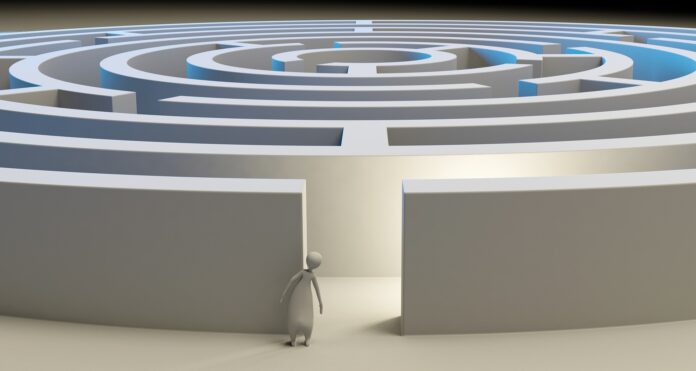

The labyrinth was a disappointment at first. I had expected curving grass footpaths bordered by neatly trimmed knee-high boxwood hedges. What I got instead was a squash-court-sized pattern in gravel. Dark road-grade crushed gravel for the paths, and dark rocks for the boundaries of the path. Gravel ramps marked turnaround points. Construction noise boomed from across the street, and a stream on the west side of the labyrinth roared across bedrock, full with winter rain.
It was January of 2024. I was in a deep bipolar low and struggled just with getting out of the house. But I knew I had to get outdoors. This was the only thing—beyond medication and counselling—that I knew would help me. So, I made a plan that would get me out to a different outdoor setting weekly for a month. I began my quest at a local labyrinth, as it was close to my home, and I thought it would be a nice and easy start to my plan in a way that would inspire a sense of mindfulness as I moved on to future monthly pursuits.
I didn’t necessarily have to leave home to follow a labyrinth. These winding paths aren’t limited to walking trails: some are carved, painted on rocks, or drawn on paper to be traced with a fingertip or by eye. But I’ve tried the paper ones and never succeeded; the paths get away from me in their recursive form, I lose my place and have to start over again and again. So, it was time to go to a labyrinth in person.
Labyrinths are an intriguing mystery—who came up with the idea? How did they decide on the design? What was their original intent? Labyrinths have been around for over 4000 years, with the earliest seen in southern European and North African cave art, and Native American art. They can also be traversed in person in India, much of Europe, and the United Kingdom. The Romans brought us the traditional seven-circuit labyrinth, while the medieval period saw the development of the 11-circuit labyrinth. Labyrinths are tiled into the floors of churches, part of highly manicured estate gardens, and in modern times have appeared in school yards and hospital gardens. They also appear more figuratively in pop culture. In the Daniel Craig movie, Knives Out, we watch a movie once, and then are shown the same movie again with all the missing details. We walk to the middle, seeing it from one perspective, then walk out, seeing it from a completely different—and highly revelatory—perspective.
Most labyrinths were constructed for religious reasons, like mine, which is on the grounds of the local United Church. From the 12th to the 14th centuries, labyrinths were constructed on the floors of churches in northern France, such as Chartres, Reims, and Amiens. While labyrinths were sometimes used as a substitute for walking pilgrimages, like the Camino de Santiago, contemporary labyrinths are often about mindfulness and letting go of stress. They’re designed for contemplation, whether or not that’s religious. Jeff Saward notes that “the experience of walking a labyrinth is often calming and restful and can be deep, profound and even life changing.” They can also be meant for healing—labyrinths at hospitals are a way to get patients outside and gently moving in a set pattern that works as therapy for the patient.
I chose to walk the labyrinth because it wasn’t a difficult walk, and was only a short drive away. It gave me a goal, something on my calendar that I knew I could do, instead of an endless parade of empty days stretching out into nothingness. I also hoped that it would help stitch together my fractured mind, that I might have a revelatory and mindful experience that would make my perambulations worthwhile.
On that first visit, under a deep grey sky in the spitting rain, looking at the disappointing gravel marking the labyrinth’s paths, I didn’t know what labyrinth etiquette was. I stepped in at the side and walked over the ramps. That would be typical of me during a bipolar high: jumping in at the middle of things, running roughshod over boundaries, and generally feeling out of control. I could see why labyrinths were constructed by Scandinavian fishing communities to ensure a safe trip by trapping malevolent trolls or winds in the labyrinth’s coils. Perhaps I could trap a bipolar high in the coils of this labyrinth over the course of my visits. But today I wasn’t on a high. I was in a low phase. So maybe the labyrinth would release some of its energy into me. Make me feel more buoyant than weighed down by my illness.
Once I finally made it to the centre of the labyrinth, I realized that there was a large boulder marking the entrance. I realized there was a pattern to be followed, a turning and turning and turning again into its keyhole heart.
Labyrinths are often confused with mazes, like the one on Knossos that housed the Minotaur. Mazes are designed to obfuscate and make it difficult to find your way out unless you have Ariadne’s yarn to follow. A labyrinth is just a single, winding path that, while it may challenge your sense of direction, is impossible to get lost in, because the path will ultimately send you to the same place you began—you just have to trust the process and keep moving forward.
I was self-conscious walking the sinuous path, my rain jacket shushing as I swung my arms. I thought people would laugh at this strange pattern I was walking, as they couldn’t see the rock pattern on the ground. But what was there to be self-conscious about? The nearby high school was in session so there was no one outside to see me. There was only one car in the church parking lot so they probably couldn’t see me. It was just me, the stones, the construction noise, the raging stream, the path from the outside to the centre and back again.
My steps on the gravel were tentative at first. Was I doing it right? Should I be walking slowly or quickly? What should I be thinking about? Is there even a “right” way to walk a labyrinth?
Labyrinths are often seen as “thin” places, where our world touches up against the “otherworld.” Anything can happen, in the heart or in the mind, across that barrier. As Antonia Malchik writes about walking a labyrinth in Norwich Cathedral, “When I finally exited, it was with an eerie feeling of having been knitted back together, not just within myself, but with far more than I could fathom.” Would I get that feeling the more I walked the labyrinth? Or was I too spiritually closed off to allow the thin places to do their work? If there’s one thing my illness has caused it’s a sort of spiritual block that my medications enforce. I don’t feel as much as I should, and it bothers me immensely.
After that first visit, I wasn’t sure if I’d go back. Nothing miraculous had happened. I didn’t feel touched by inspiration or healing. It was just me, in the light rain, learning to follow the pattern that was laid out before me. Backtracking on my initial boorish steps to walk the labyrinth properly. But I decided to give it another chance. Maybe I just had to get over my initial self-consciousness, my skepticism that a labyrinth would do anything for me. Plus I really needed to get out of the house, and I was stubbornly holding myself to the plan of getting outside once a week.
On my second visit to the labyrinth, there were children screeching in the adjacent play area. I tried to tune them out as I walked my path, around and through, in and out. Slowly I figured out how the labyrinth was formed, and made my way to its centre. This visit was a lot better—I understood where I could and couldn’t walk, and could let my feet go while my mind wandered. Until I tripped over a border rock, that is. So, I kept my eyes partly on my feet and partly on the middle distance, trying to combine the two in my mind. It occurred to me that walking a labyrinth is like writing a book: you write your way into it, then have to walk backwards for revision, looking for sections to change, and identifying where the bones of the story are showing through that you have to flesh out.
Did the labyrinth work? Did it calm my mind and counter the negative thoughts that constantly besiege me? Not really. I spent half an hour there, wandering in and then out of the path. Walking forwards from the entry and back out from the middle. I began to recognize certain stones—the one with the white circle that looked painted on. The one that looked like a pumice stone. I always kicked the same rocks by accident: the black one on the corner of the first turn, or the big grey one just before the final curve that led me into the centre of the labyrinth. I had to stop and move them back into line with the others. My mind wandered through everyday thoughts, tasks, to-do lists, etc. I briefly found a calm inner space while walking, but it was fleeting.
Katherine May writes, “…the labyrinth represents life’s journey, or a journey of the mind…It promises no miracles, but rewards patient practice. It is, in a sense, a tangled thing that unravels if you just keep going forward.” I felt this in my bones, that the labyrinth would reward my patience and unravel my tightly twisted heart. I just had to keep at it.
So, I went back for a third time, to practice patiently. This time it was pouring rain, but I wouldn’t be kept away from my weekly outing. The grass around the labyrinth was slick with mud while huge puddles covered the gravel paths. I had my umbrella up, and was pelted with cold raindrops that numbed the hand holding it pretty quickly. This time I knew what to do. I walked to the boulder then stepped into the labyrinth, starting my perambulations around the circle. All I could focus on was my cold hand and the puddles on the path. I tried to focus just on the rocks, the walking meditation labyrinths are meant for. It sort of worked, until the wind threatened to blow my umbrella away. I stopped walking and held on tight as I pushed the umbrella into the wind and rain to stop it from flipping inside out. Once I had it under control again, I walked the labyrinth from the centre to the entrance, crunching along the gravel—back and forth, around and around, thinking. About my next book. About whether I’d be too tired to stay up once I got home. My mind ran in circles as I looped and looped and looped again.
Malchik also writes about walking an outdoor labyrinth: how she was compelled to take her shoes off and feel the grass under her feet. How her steps slowed, noticeably, until “for one long stretch I was barely walking forward at all.” I envied her the connection with her labyrinth. I couldn’t walk mine barefoot because of the gravel. And I didn’t feel the draw to walk more and more slowly. I just felt the steadiness of the pattern: there was no other way to go except where the paths took me. I didn’t have to make any decisions; I just followed my steps in and out and in and out. This proved particularly helpful since the low phase of my illness makes decision-making so hard: I can hardly decide what to have for lunch, let alone what I’m going to do the next day or week. But here, the labyrinth laid out my path before me, saying “walk this way.”
I went back for a fourth time, on a clear and chilly day, in a warm jacket and toque. No pouring rain. No mud. Just sun and heavy frost. I tried to be more purposeful this time, but ended up getting a bit dizzy on some of the tighter, repetitive twists and turns. I imagined that I was walking on a mountain trail and had to watch my footing. But I felt clumsy, my feet catching at rocks along the path, not pivoting gracefully at the turns. The path is only half a metre wide, so that was part of it. But the other part was me. I was checking my watch, wondering how long it took me to complete the labyrinth once (six minutes). I was distracted by a man walking his dog nearby, and a couple of high school kids slinking into the woods to do whatever secret thing they couldn’t do on school grounds. I wasn’t “present.”
For the last two rounds, one in and one out, I focused hard on just being immersed in walking. I realized I had to put some effort into maintaining mindfulness in the labyrinth—it wouldn’t do it for me. It was a struggle, and I didn’t feel relaxed when I was done. Mindfulness is hard work, and I felt that the labyrinth had exposed my lack of spiritual being. As I photographed the frosted labyrinth, ice crystals shimmering in the cold early morning light and the rocks casting shadows on the frozen ground, I realized it was the first time I’d seen it in the sun.
On my final visit, it looked as though kids had been let loose on the labyrinth. There was a half-eaten carrot in the centre, and many of the rocks that defined the path had been kicked to the side. I busied myself with tossing away the carrot and realigning the rocks. Tidying up what I saw as my touchstone, my responsibility. I had been coming here once a week for five weeks, and felt as though I was visiting an old friend who needed some help from time to time.
The trick with the labyrinth is that you have to do it both forwards and backwards to get out of it. I reached the centre and started to go backwards to the outside. If I could just set my outgoing footprints directly into my incoming footprints, my thoughts would fall into an equally predictable place with an almost audible click and suddenly it would all make sense: the path, the rocks, the book, the illness.
Maybe I was asking too much of the labyrinth. It should make us feel we’re navigating the path of our destiny, which leads us inexorably to the centre of our lives. We question what we know about ourselves and who we want to be in the world as we walk in; we walk back out into that person.
******
***
The ManifestStation publishes content on various social media platforms many have sworn off. We do so for one reason: our understanding of the power of words. Our content is about what it means to be human, to be flawed, to be empathetic. In refusing to silence our writers on any platform, we also refuse to give in to those who would create an echo chamber of division, derision, and hate. Continue to follow us where you feel most comfortable, and we will continue to put the writing we believe in into the world.
***
Write for your Life with The Craft School
CRAFT SCHOOL is a vibrant community for writers led by Jeannine Ouellette, Emily Rapp Black, and Gina Frangello—three established writers with extensive teaching experience. They believe, and we agree, that when a community is both safe and rigorous, writers and their work flourish.
***
Inaction is not an option,
Silence is not a response
See our Resources and Readings

Thank you. Your story brought to mind an extraordinary labyrinth built at low tide at Spanish Banks in Vancouver. We walked in and out as the sea raced in to cover it – and our footsteps. I didn’t know enough to question if it were 7 or 11 circuits.I will look for that next time. And question more mindfully who I want to be in the world as I walk out.