
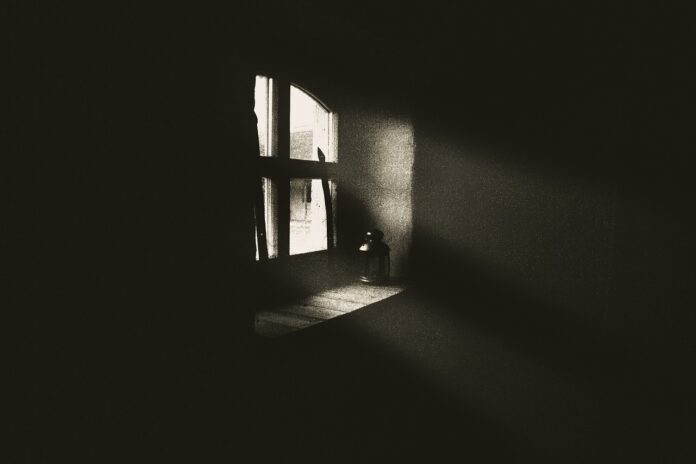

For as long as I can remember, I’ve been depressed. And not the gray skies, case of the Mondays, feeling a little blue sort of depression. But the kind that you can fall into as easily as you fall into sleep. The sort that makes people uncomfortable, the kind of suffocating, all-encompassing depression. A pit you can’t climb out of.
The pit is inside me, hidden in some infinitesimal part of my being where my nerve-endings can’t feel it. Most days it stays like that, a dark, invisible pit, the kind soldiers in Vietnam would get their foot stuck in before their face is blown off by a bouncing Betty.
But there are no soldiers here.
No bombs.
There’s only it—the Pit, and me, sinking in its depths.
Growing up, I was told that I wasn’t allowed to be depressed—not in those explicit words of course—no, but the message was clear enough, smuggled in by elders asking their well meaning half-rhetorical questions. What do you have to be depressed about? You’ve got food in your stomach, clothes on your back don’t you? You ain’t homeless are you? And really, depression ain’t real, that’s just some white people shit.
So, they’d tell me, you’re alright. Their words transformed me, like the Blue Fairy waving her magic wand over Geppetto’s wooden boy, I was fine.
I am fine.
I have to be fine.
But the pit is still there.
And there’s no amount of ignoring it, or telling it that it doesn’t exist will make it go away. No magic wands, or moving speeches that will close it up, at least none that worked yet. It is a hole, the kind with no bottom, empty and not. At night if you listen close, put your ear to my chest, or the ground you can hear the noises that come out of it—an endless crying to be filled, a relentless eagerness to be filled with something. Anything. But there’s nothing that fits, no scraps of affection: no sacrifices of food, no amount of getting high, of rereading favorite books, of falling into comfort video games can fill it.
***
This, is by design I suppose, pits, even ones like mine have a singular purpose—for someone to fall into. And no amount of razor wire or stop signs will stop that, can stop that. It’s like Chekhov’s gun, but instead of a gun it’s the unyielding feeling that I am alone and will probably die alone—the fear that my existence is a burden. And I am just waiting…
waiting
waiting…for the next shoe to fall, for the inevitability of comforting voices in the pit to be right. Because the pit isn’t all bad, it can’t be, otherwise how would it draw anyone into it, like flies into a spider’s web. It makes itself a safe place to land after life has gotten a few hits in, and it makes sure you know it’s safe with flashing neon signs big and bright enough to render all the “do not enter,” and stop, and “danger beyond this point,” signs invisible.
What did The Eagles say? “You can check out any time you like, but you can never leave.”
The pit isn’t a place you leave. You can’t. It isn’t a pit if you can leave, if you can just crawl out and return to your life, it would be something else.
I should make it known now that I’m not interested in dying. I don’t exactly love living, but I think there are things worth living for: movies and art, writing moody think pieces no one will read, my many, many projects. My husband. Most of the things I hate about life can easily be attributed to capitalism, to this broken world we live in.
But I would be stupid if I didn’t recognize how much better people’s lives would be without me in it; I ruminate on this a lot like a cow chewing cud. At least that’s what the voice in the pit says, what it whispers into my ear when the proverbial theater has closed its curtains and the lights turn back on. I ruminate on the pit’s seductive whispers, like a cow chewing cud. My own personal Wormtongue, is always eager to share the world’s secrets with me. And it’s all too easy to listen. To drink that poison like wine and lie, in suffocating silence within it. The Pit.
Which means, I’ve tried dying before, taken dehumanizing trips to the grippy sock hotel. It didn’t make me feel better, and the looks from friends made me feel worse.
You know the look.
That sad pitying look, the look people give people like me when we’ve stepped out of place. It’s in those dark moments that I at last understand the wisdom my elders were trying to impart on me. I carry with me the sin of Blackness—some ancient negro curse—that transforms my flesh and bone into Wedgwood so my black ass can dance into oblivion. I want to be a real boy so bad, but someone decided a long time ago that I’m Black, that I don’t get to be a real boy, a real anything for that matter. I can be a lot of things of course, I can be useful—society loves it when us Blacks are useful—I could even be entertaining. Or a statistic, White people love their easy boxes to place the wrong kinds of non-people, a mirror to reflect all their feelings at. But depression? That’s not for us. No. Depression is white people shit.
Hi! Let’s take a detour and talk about race a moment!
Nothing makes White people more uncomfortable than a Black person’s emotions, to have the illusion broken, to be confronted with the humanity of those deemed non-human. I’m Black, I was never meant to be human—I was never meant to be seen as anything other than what piece of myself I can give to others, how beautiful I can stretch, can dance, can perform.
***
When you are in the pit, like I often am, you aren’t invisible, though you may wish to be. People can see your suffering, your fuse burned short, your hollowed out eyes, the deep hole in your gut that goes on forever. They can smell it on you like salt in the air, and when those people smelling your weakness on you are White, and you are Black. That anger twisting through you makes them fearful, they’re disgusted by my anxiety, and my depression? Oh, it makes their skin crawl. They creep around me as if I’m contagious, part away from my being like schools of fish in the presence of a shark. But I’m not a rabid animal waiting to be put down, a monster to overcome. I just don’t have the energy to dance, to perform. But whiteness says there’s no difference. Like an alchemist transforming a lump of iron into gold, the same is done to my humanity.
That’s what the elders meant all those years ago, that there’s nothing more dangerous than existing while Black, that if you love being alive, you’ll go back to being Geppetto’s little dancing marionette. You’ll paint that smile on red and wide, and get back to dancing.
Black people don’t get to be sad.
Moments of weakness aren’t for us.
Like Sisyphus, if you’re Black, you’ve got to shoulder that boulder, and when and if it inevitably rolls down that hill you better smile and ask for another.
***
Let’s get back to that pit now.
***
I have been trapped in that pit for what feels like three months, perhaps it’s been longer. It’s been hard trying to pull myself out of it, the pit isn’t made for leaving. Its comfortable walls were built with a long stay in mind.
It usually creeps up on me around October or November so slowly I don’t know what’s happening until December, and by then it’s already too late.
They say if you spot a polar bear in the wild, it’s already too late, they’ve already been hunting you—tracking you and that if you’ve managed to spot it lumbering across the ice, it’s only because it’s going for the kill. Depression is similar.
Holidays are hard for me, I’m not sure what about them is hard, just that they are, and they’ve been getting harder. Christmas eve I spent the evening weeping in my husband’s arms, burrito’d in several layers of blankets. I had tried spending the evening with friends but it was too much, I felt exposed in a way I had never felt before and had to retreat.
It was an intense moment of vulnerability that I feel haunted by, and that has in a way, leeched into the ground water of every aspect of my life since.
I didn’t know how disgusted I made everyone feel, but I heard about it later. Talks not of concern but indignation that I could dare let the mask slip. That I dared to stop dancing.
I haven’t danced since Christmas, and I can’t help but notice the air that gets sucked out of the room when I enter it. How people’s bodies beg for egress when I am present. My depression renders them uncomfortable, as if my inability to shuck and jive were roaches dancing across their skin.
***
I don’t know what to do with that. But I know what my elders have told me. And perhaps that’s the reason why the hair on the back of my neck hasn’t laid flat in weeks. That danger sense rolling through my bones, warning me the way the elders did all those years ago.
A moment of vulnerability on my part transmuted into something dangerous. I had broken the social contract. My failure to dance made people uncomfortable. And it isn’t the first time I had to learn that lesson.
***
When I was suffocating under the weight of a racist roommate, I was met with the threat of withdrawal because my vulnerability made my friends uncomfortable.
I didn’t realize then what I know now, that elders were right all those years ago. People, white people, can only love or appreciate Black people so long as they’re fulfilling their role as entertainers. The dancing monkey isn’t supposed to have needs, isn’t supposed to remind the dutiful audience that the wood and strings are all for show, that beneath the Wedgwood paint is a real person, a human.
You’re Black, you’re meant to smile, meant to dance.
Depression is a privilege only afforded to real people. A Black person can be a lot of things, but for the comfort of whiteness, real will never be one of them.
But I can’t dance anymore, eventually even Sisyphus must get tired of rolling that boulder up the hill.
So, that leaves me one choice, nestled at the bottom of this pit. Suffocating, but real, Black, and depressed. And that has to be okay.
******
***
The ManifestStation publishes content on various social media platforms many have sworn off. We do so for one reason: our understanding of the power of words. Our content is about what it means to be human, to be flawed, to be empathetic. In refusing to silence our writers on any platform, we also refuse to give in to those who would create an echo chamber of division, derision, and hate. Continue to follow us where you feel most comfortable, and we will continue to put the writing we believe in into the world.
***
Write for your Life with The Craft School
CRAFT SCHOOL is a vibrant community for writers led by Jeannine Ouellette, Emily Rapp Black, and Gina Frangello—three established writers with extensive teaching experience. They believe, and we agree, that when a community is both safe and rigorous, writers and their work flourish.
***
Inaction is not an option,
Silence is not a response
See our Resources and Readings

